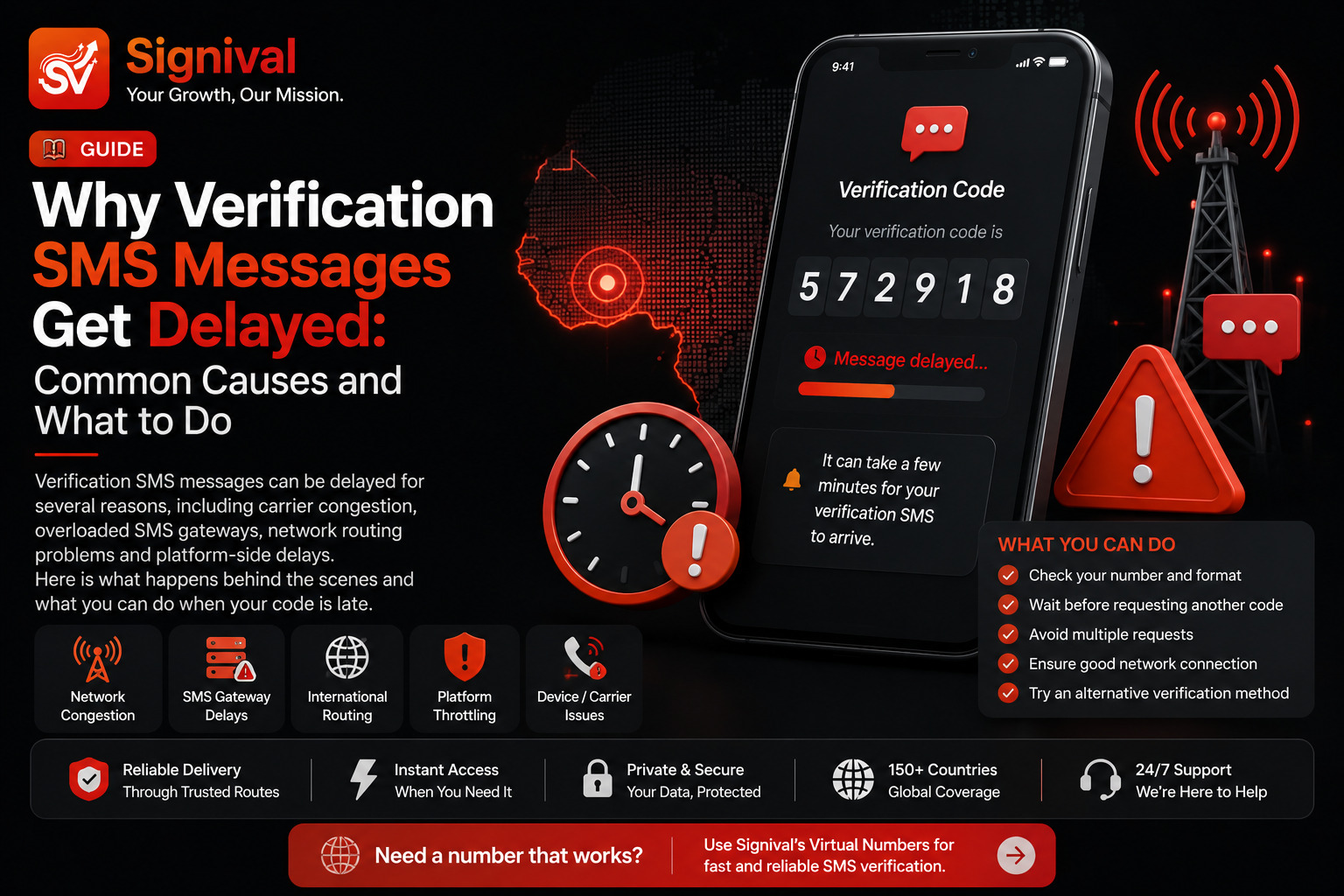
Why Verification SMS Messages Get Delayed
Waiting for a verification code that never seems to arrive is one of the most frustrating parts of creating an online account. You enter your phone number, request the code, wait a few seconds, check your messages again, and still nothing appears.
In some cases, the message eventually arrives several minutes later. In other cases, it never reaches the phone at all.
This does not necessarily mean that your phone number is invalid. Verification SMS messages pass through several systems before they reach your device, and a delay at any point in that chain can affect delivery.
This guide explains the most common reasons verification SMS messages are delayed, what happens between the website sending the code and your phone receiving it, and what you can do when a verification message is taking too long.
Explore Signival's SMS verification service
What Happens When a Website Sends a Verification SMS?
When you enter your phone number into a website or application and request a verification code, the platform normally generates a temporary code and sends it through an SMS delivery system.
The process is more complicated than simply sending a text message from one phone to another.
A simplified version looks like this:
Website or application → SMS gateway → telecommunications network → mobile network → your phone
The website first creates the verification code. It then sends the number and message to an SMS provider or messaging gateway. That provider attempts to route the message through an appropriate telecommunications network until it reaches the carrier serving your phone number.
Every additional system involved creates another point where delivery can slow down.
This is why a verification code can sometimes appear immediately while another code from a different service can take several minutes.
1. Mobile Network Congestion
One of the simplest explanations for a delayed verification SMS is congestion within the telecommunications network.
Mobile networks handle enormous volumes of SMS traffic every day. Verification messages are only one category of that traffic.
When traffic increases or a particular routing path becomes congested, messages can take longer to move through the network.
This can be particularly noticeable when several services are sending large numbers of automated messages at the same time.
The important point is that the delay can occur after the website has already successfully generated and dispatched your code.
In that situation, repeatedly clicking "send code" may not solve the underlying problem. You may simply create several valid codes that are all waiting to be delivered.
2. The SMS Gateway Is Experiencing Delays
The application you are using may rely on an external SMS gateway to deliver verification messages.
If that gateway is processing a large volume of messages, experiencing a routing problem, or having difficulty connecting to a particular carrier, messages can be delayed.
This is especially relevant for international services sending verification messages to Nigerian numbers.
The company sending the message may be located in another country, while its SMS provider has to establish a route through one or more telecommunications networks before the message reaches the Nigerian carrier.
A problem anywhere along that route can introduce additional delivery time.
3. International SMS Routing Can Take Longer
Not every verification SMS originates from a company operating inside your country.
A Nigerian phone number may be receiving a verification message from a platform whose messaging infrastructure is located elsewhere.
International SMS traffic can involve additional routing arrangements between messaging providers and telecommunications carriers. If a particular route is slower or temporarily unavailable, delivery can be affected.
This is one reason why a normal SMS from a local contact can arrive instantly while an automated verification message from an international service takes considerably longer.
4. The Platform Has Delayed the Verification Request
Sometimes the telecommunications network is not the problem at all.
The website or application itself may delay the request.
Large platforms often apply automated controls around verification requests. These controls can include request throttling, temporary limits, traffic management and additional checks.
If you request several codes in a short period, the platform may not process every request immediately.
This is particularly important when troubleshooting a missing code. Pressing the "resend" button repeatedly can make it harder to determine which code is actually current.
5. Too Many Verification Requests
Repeated verification attempts are another common reason users experience confusing SMS behaviour.
Suppose you request a code at 10:00:00 and do not receive it. You request another at 10:00:30 and then another at 10:01:00.
If the earlier messages are delayed in transit, several codes may eventually arrive together.
Some platforms also invalidate previous codes when a new code is requested.
That means the first code may arrive after the second request but no longer be valid.
For this reason, it is usually better to wait for the platform's stated delivery period before requesting another code.
6. Carrier Filtering and Message Handling
Mobile carriers use filtering systems to identify and manage certain types of automated messaging traffic.
Verification messages are legitimate transactional messages, but automated SMS traffic can still encounter filtering or routing issues.
This does not mean that every missing verification code has been blocked by your carrier. It simply means that message handling is another part of the delivery chain that can affect timing.
7. Your Phone May Be the Final Point of Delay
Sometimes the message has already reached the mobile network but is not immediately visible on your device.
Temporary network registration problems, weak connectivity, device messaging issues, or a full SMS inbox can interfere with normal message reception.
If other SMS messages are also arriving late, the problem may be closer to your device or mobile network rather than the website you are trying to verify.
8. The Number Format May Be Incorrect
A surprisingly simple problem is an incorrectly entered phone number.
International services commonly expect numbers in international format. For a Nigerian number, that can mean using the appropriate country code instead of entering the local format incorrectly.
If the number is entered incorrectly, the verification request may be routed somewhere else or rejected before the SMS reaches your device.
Always check the country selected and the complete number before requesting another code.
How Long Should You Wait for a Verification SMS?
There is no universal delivery time for every verification SMS.
Some messages arrive within seconds. Others can take several minutes depending on the platform, SMS provider, carrier and network conditions.
The most useful approach is to follow the waiting period displayed by the platform rather than immediately assuming the number has failed.
If the service provides a countdown before another request can be made, allow that period to complete.
What to Do When a Verification SMS Is Delayed
If you have requested a verification code and it has not arrived, work through the problem systematically.
1. Confirm the phone number. Check the country code and the complete number.
2. Check your mobile connection. Make sure your phone is connected to the mobile network normally.
3. Wait before requesting another code. A delayed message may still be travelling through the delivery route.
4. Avoid repeatedly requesting codes. Multiple requests can invalidate previous codes or trigger temporary platform limits.
5. Check whether other SMS messages are arriving. If ordinary messages are also delayed, the issue may be network-related.
6. Try the platform's alternative verification method if available. Some services may offer voice verification or another supported method.
7. If the problem continues, consider another supported verification route.
For users who need a separate temporary number for a supported SMS verification process, Signival provides temporary SMS verification numbers through its online dashboard.
Why a Temporary Verification Number Can Help
Not every verification problem is solved by switching numbers. If the platform itself is experiencing an outage or its SMS infrastructure is delayed, changing the number may not make a difference.
However, a temporary number can be useful when you specifically want to keep your primary phone number separate from a registration or one-time verification process.
Instead of waiting for a verification SMS on your personal SIM, you can request a supported temporary number and monitor the incoming verification message through the service interface.
Signival's Virtual Numbers service is designed for this type of temporary verification workflow, subject to the availability of numbers and the supported platform.
Why Verification Codes Sometimes Arrive After You Give Up
One of the most confusing experiences is receiving a verification code several minutes after you stopped waiting for it.
This usually happens because the SMS was not necessarily lost. It was delayed somewhere in the delivery chain.
For example, the platform may have generated the code immediately, while the SMS gateway or carrier route took longer to deliver the message.
If you have already requested a newer code, the late message may also be irrelevant because the platform may have invalidated the earlier code.
That is why it is better to use the most recent valid code shown by the platform rather than assuming the first message to arrive is the correct one.
Does Changing Your Phone Help?
Not necessarily.
If the problem is caused by the website, SMS gateway or telecommunications route, moving the SIM card to another phone will not fix the underlying problem.
Changing devices is more useful when other SMS messages are also failing to arrive or when there is a clear problem with the device's messaging functionality.
Before changing devices, determine whether the problem affects only one verification service or all incoming SMS messages.
Verification SMS Delays Are Not Always a Sign of a Bad Number
A delayed verification message does not automatically mean that your phone number is invalid.
SMS delivery involves several independent systems, and a problem with any one of them can affect the final delivery time.
The most important thing is to identify where the delay is occurring before repeatedly changing numbers or requesting new codes.
If you regularly need temporary numbers for supported verification workflows, you can explore Signival's virtual numbers or learn more about its SMS verification service.