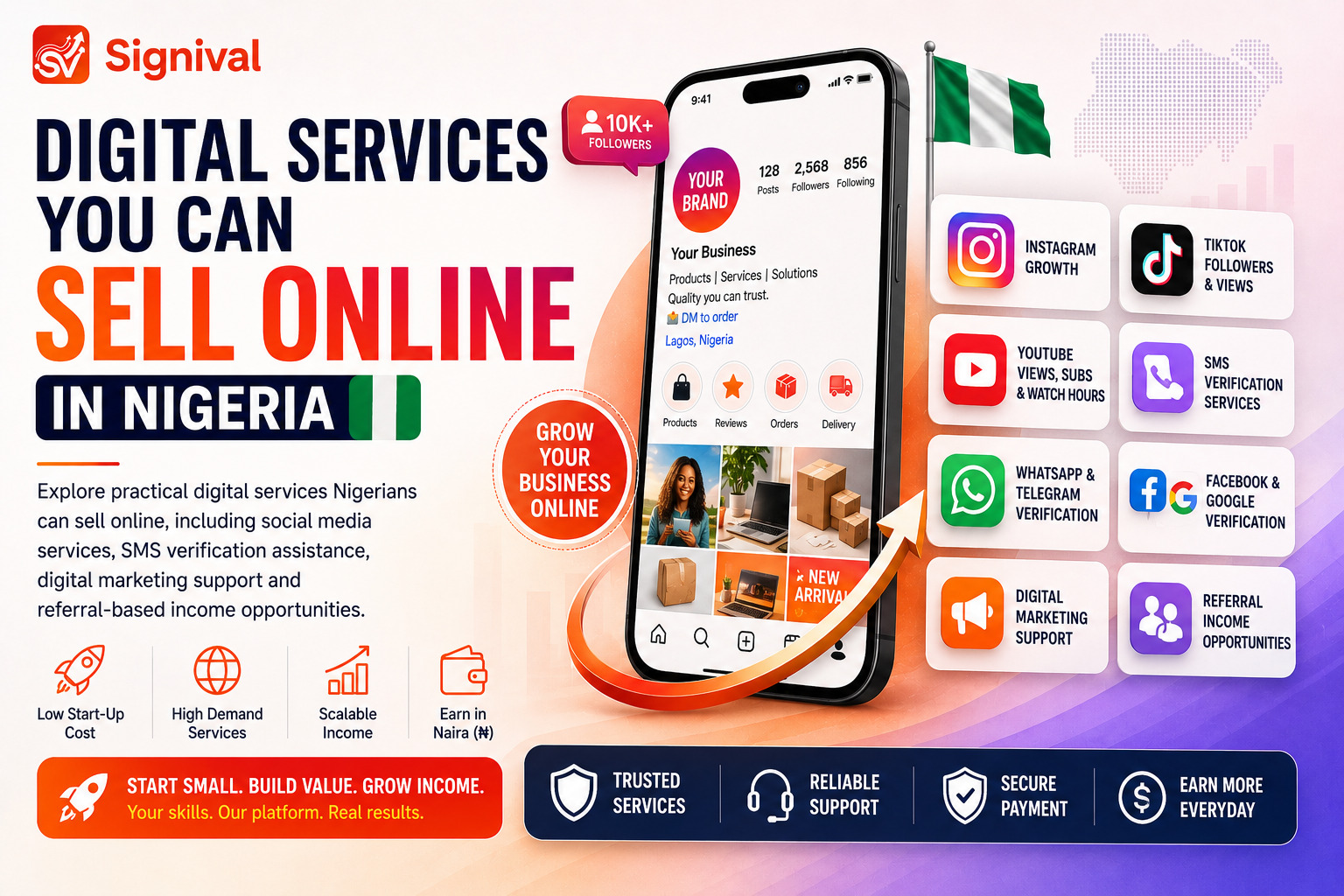

You Do Not Have to Build the Infrastructure to Sell the Service
One of the biggest misconceptions about starting an online service business is that you need to build the technology behind every service you sell.
You do not.
A business can own the customer relationship while relying on an external platform for fulfillment.
Think about the structure of many ordinary businesses. The company that sells a product to the customer is not always the company that manufactures every component of that product.
Digital services can work in a similar way.
You can find the customer, understand what they need, set your selling price, collect payment and manage the relationship while Signival provides the infrastructure required to fulfill supported SMM and SMS verification services.
Explore Signival's SMM services
The Basic Business Model
The model can be summarized in five stages:
1. Find the customer.
Someone needs a service.
2. Sell the service.
You explain what you provide and agree on a price.
3. Receive payment.
The customer pays your business through your chosen payment method.
4. Fulfill the request.
You use Signival to obtain the required SMM service or supported temporary verification number.
5. Keep your margin.
The difference between your customer price and your fulfillment cost contributes to your gross margin.
This is the basic infrastructure model behind many digital reselling businesses.
Why Build a Business Around Existing Infrastructure?
Building infrastructure from scratch can be expensive and technically demanding.
An SMM platform, for example, may require supplier integrations, service synchronization, order processing, delivery tracking, wallet management, failed-order handling and customer support infrastructure.
A temporary SMS platform has its own challenges, including number inventory, provider connections, activation management, SMS retrieval and transaction handling.
If your immediate goal is to sell digital services, building all of this before finding customers can be a poor allocation of time and money.
An existing platform lets you concentrate on the commercial side first.
Using Signival for Social Media Services
Signival's SMM infrastructure can be used as the fulfillment layer for supported social media services.
Depending on the services currently available, these can include Instagram followers, TikTok followers and views, YouTube services and other social media metrics.
You can therefore create your own customer-facing packages around the services you want to sell.
For example, imagine that you sell an Instagram growth package to a local business.
The customer does not necessarily need to interact with your fulfillment platform.
You receive the customer's public profile URL, select the appropriate Signival service, submit the required quantity and monitor the order.
Instagram fulfillment services
Using Signival for SMS Verification Services
The same infrastructure concept can apply to supported SMS verification services.
A customer may need a temporary number for a supported verification workflow. Instead of maintaining your own pool of numbers, you can use Signival's available virtual-number infrastructure to fulfill the customer's request.
You can help the customer select an appropriate available service, provide the number and assist them in receiving the verification SMS.
As with any verification service, you should be clear about limitations. The platform requesting verification controls whether a particular number is accepted and whether a verification message is sent.
Explore Signival Virtual Numbers
The Customer Relationship Is Still Yours
Using external infrastructure does not mean you have to outsource your entire business.
You can still control:
Customer acquisition — how people discover your business.
Pricing — how much you charge for your service.
Communication — how you handle questions and complaints.
Packaging — how you combine individual services into offers.
Customer support — how you communicate delivery progress.
Branding — how customers perceive your business.
Profitability — how you manage the difference between revenue and fulfillment costs.
Signival is the infrastructure layer. Your business is the customer-facing layer.
Example: Selling an Instagram Service
Suppose you identify a small Nigerian fashion business that wants to improve the initial presentation of its Instagram profile.
You create a package that you sell for ₦20,000.
After the customer pays, you log into your Signival account and select the appropriate Instagram service.
Suppose the fulfillment cost is ₦13,000.
Your gross margin on the fulfillment portion is:
₦20,000 − ₦13,000 = ₦7,000
That does not mean you have ₦7,000 of pure profit. Your actual profit still depends on other expenses involved in acquiring and servicing the customer.
But the example demonstrates the model.
You did not need to build the infrastructure that delivers the service.
You built the business around the infrastructure.
Example: Selling an SMS Verification Service
Now consider a customer who needs a temporary number for a supported SMS verification workflow.
You can charge the customer a service price that includes your handling fee and fulfillment cost.
Once payment is confirmed, you obtain the appropriate available number through Signival and guide the customer through the verification process.
Your margin comes from the difference between what the customer pays and what the fulfillment costs you.
View available virtual-number services
How to Set Your Prices
Pricing should begin with your fulfillment cost.
Do not simply look at what competitors charge and copy their price.
First determine:
Fulfillment cost — how much the Signival order costs.
Payment costs — what you spend receiving or processing customer payments.
Customer acquisition cost — how much you spend finding customers.
Support cost — the time and resources required to handle customers.
Risk allowance — failed orders, refunds and other operational issues.
Then determine the margin you need.
A simple formula is:
Selling price = fulfillment cost + operating costs + desired margin.
Do Not Compete Only on Price
If your only selling point is that you are cheaper than another reseller, someone else can eventually undercut you.
Instead, compete on the complete customer experience.
You can make your service more valuable through:
Fast responses.
Clear explanations.
Simple ordering.
Accurate service selection.
Order tracking.
Professional communication.
Transparent pricing.
Reliable fulfillment.
The infrastructure handles the technical fulfillment. Your business can focus on making the process easier for the customer.
Building Your Own Brand Around the Service
You do not have to advertise yourself as a reseller.
You can build a proper digital-services brand around the problems you solve.
For example, instead of saying:
"I resell SMM services."
You could position your business around helping Nigerian businesses and creators manage their online growth services.
Instead of:
"I sell temporary numbers."
You could position the business around providing temporary SMS verification assistance for supported platforms.
The difference is subtle but important. You are building a service business rather than simply forwarding customers to another website.
Keep Your Fulfillment Costs Separate From Your Customer Revenue
As the business grows, record every order.
For each customer, track:
Amount charged
Fulfillment cost
Gross margin
Service purchased
Order ID
Customer
Date
This makes it possible to determine which services are actually profitable.
A service with a high selling price is not necessarily more profitable if it also has high fulfillment and support costs.
Why the Naira Wallet Matters for Nigerian Businesses
Currency conversion can make digital-service reselling unnecessarily complicated.
If you charge Nigerian customers in Naira but your supplier charges you in another currency, every order requires an additional conversion calculation.
Signival's Naira wallet allows Nigerian users to fund their fulfillment balance locally and deduct supported orders from that balance.
That makes your cost calculation easier because your customer revenue and fulfillment expenses can be tracked in the same currency.
Fund your Signival wallet and explore SMM services
Combining SMM and SMS Services
You do not have to choose only one digital-service category forever.
A business that starts with social media services can later add supported SMS verification services.
For example, you might initially sell:
Instagram followers.
TikTok views.
YouTube services.
Then expand into:
WhatsApp verification numbers.
Telegram verification numbers.
Facebook verification numbers.
Google/Gmail verification numbers.
This gives you multiple service categories while keeping the underlying fulfillment process relatively centralized.
The Customer-to-Fulfillment Flow
A mature digital-services business can operate using a repeatable workflow.
Traffic
People discover your business through Google, social media, referrals, advertisements or direct outreach.
Inquiry
The customer asks what you offer.
Quote
You explain the service and provide your price.
Payment
The customer pays you.
Fulfillment
You place the corresponding order through Signival.
Tracking
You monitor the order and handle any required customer communication.
Completion
The customer receives the service.
Repeat purchase
If the customer needs the service again, you already have an established relationship.
This repeat-purchase stage is where a small service business can become much more valuable over time.
The Separate Referral Opportunity
There is another opportunity that is different from reselling services yourself.
If you participate in Signival's referral program, you can introduce other people to the platform and earn according to the program's applicable terms.
This means there are two different ways the platform can potentially contribute to your digital-services business.
First: Fulfillment income.
You acquire customers yourself, charge them your own price and use Signival to fulfill their orders. Your margin comes from the difference between your selling price and fulfillment cost.
Second: Referral income.
You refer users to Signival. If those users place qualifying orders under the referral program, you can earn referral income according to the program's terms.
These are separate models and should not be confused.
Learn about the Signival referral program
What You Should Not Promise Customers
Using an established fulfillment platform does not mean you can guarantee outcomes that the underlying social platform or verification service does not control.
Do not promise that purchased social metrics will automatically produce organic followers.
Do not promise that a particular number of views will guarantee monetization.
Do not promise that every temporary phone number will be accepted by every website.
Do not advertise verification as a guaranteed result when the destination platform controls the verification process.
Professional businesses explain the service honestly and set realistic expectations.
When Should You Build Your Own Infrastructure?
Using an existing platform does not mean you can never build your own technology.
If your business eventually reaches enough volume, building custom infrastructure may become worthwhile.
But that decision should come after you have proven demand.
If you have no customers yet, spending months building supplier integrations and complex automation may solve a problem you do not actually have.
Start with fulfillment infrastructure that already exists. Prove that customers will pay you. Learn which services generate demand. Understand your margins.
Then decide whether owning more of the infrastructure makes financial sense.
A Practical Starting Point
If you want to test this business model, start with one category.
Choose either SMM or supported SMS verification services.
Learn the services.
Understand your fulfillment costs.
Create three or four simple customer packages.
Find your first customers.
Track every order and every naira.
Improve your process.
Then expand.
Final Thoughts
The biggest advantage of using existing infrastructure is that it allows you to focus on the part of the business that customers actually see.
You do not need to spend your first months building an SMM supplier network or SMS activation infrastructure.
You can build the customer side of the business first.
Find customers. Create useful packages. Price them properly. Fulfill orders through reliable infrastructure. Provide good support. Track your margins.
Signival can sit underneath that process as the fulfillment infrastructure for supported SMM and temporary-number services, while your own business handles customer acquisition, pricing and relationships.
And separately, the referral program provides another potential revenue channel for people who introduce new users to Signival.